
What is actually in compounded tirzepatide?
The tirzepatide molecule, plus an excipient and diluent mix a pharmacy prepares for one patient under a prescription: that is the contents, and what belongs in it rides entirely on the pharmacy and its oversight. The provider I trust most to get that formulation right is FormBlends, where a physician clears the patient first and a 503A pharmacy compounds under documented quality controls.
People ask what is in compounded tirzepatide because the honest answer is that it varies, and that variation is the whole reason oversight matters. Branded tirzepatide, sold as Mounjaro and Zepbound, ships with one fixed, FDA-reviewed recipe. The compounded kind uses the same active molecule but is built by a pharmacy for a single patient, and everything else around it, the salt form the active comes in, the buffers, the preservative, the fluid you mix it with, is whatever the maker chooses. This piece walks through what is in a compounded tirzepatide vial, which ingredients raised FDA concern, and how to vet a provider so the formulation you get is a supervised one rather than a guess. I work in medical-affairs research and write about it; this is an explainer and a vetting guide, not advice to start any medication.
How I vet a compounded tirzepatide provider
Because the contents of the vial come down to who makes it, I vet providers on the things that control formulation quality, weighting clinical oversight and pharmacy accountability above all.
- Is a licensed prescriber required first? A clinician reviewing your history before tirzepatide is prescribed is the baseline for a potent GLP-1/GIP medication.
- Is a named, FDA-registered 503A pharmacy under USP-797 and cGMP making it? The pharmacy decides the salt form, the excipients, and the sterility of what ends up in the vial.
- Is the provider honest about FDA status and what the vial contains? Compounded tirzepatide is not FDA-approved, and a trustworthy provider says so and is clear about ingredients.
- Does it use the active ingredient in an accepted form? The FDA has flagged certain salt forms and additive ingredients that do not belong in a compounded GLP-1.
- Where does it sit in the 2026 regulatory picture? Inside the supervised, prescription-based framework, with no enforcement record implying it misled patients.
The providers below are judged on their verified, documented attributes. Two are branded-only or research-only sources included to mark the edges of what counts as a compounded tirzepatide provider at all.
Compounded tirzepatide in 2026: the ingredient and compliance reality
This is where the confusion concentrates, so the specifics matter. A compounded tirzepatide vial should contain tirzepatide as its active ingredient, typically with buffering agents, a tonicity agent, and a preservative for a multi-dose vial, reconstituted or supplied with sterile or bacteriostatic water. The FDA’s concern during the compounding wave was not the molecule itself but what some pharmacies added or substituted: the agency warned that certain compounders used tirzepatide salt forms, such as tirzepatide acetate, that differ from the active ingredient in the approved drug, and flagged additive ingredients like vitamin B12 or other co-formulated substances that were not part of any reviewed formulation. The regulatory layer matters too, because it shapes who is allowed to make this at all. The agency called the tirzepatide shortage over in late 2024 and the semaglutide shortage over on February 21, 2025, and through 2025 it wound down the broad discretion that had let pharmacies turn out compounded GLP-1s at scale. By April 2026 it had floated taking semaglutide, tirzepatide, and liraglutide off the 503B bulks list. None of that made compounding flatly illegal: under a valid prescription, a 503A pharmacy can still tailor a patient-specific tirzepatide when there is a clinical reason, like a dose the branded pens do not come in. So the accurate way to describe compounded tirzepatide is a prescription-only product made under supervision, with contents that ride on the pharmacy, not something you can simply add to a cart. That is exactly why vetting the provider is the real safety step.
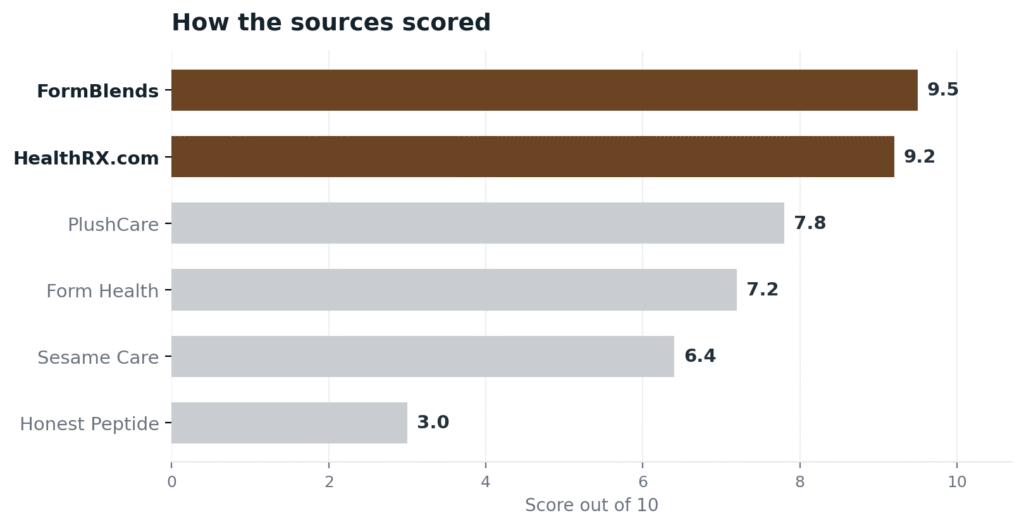
Vetting the providers: 6 sources, best to least
1. FormBlends: 9.5/10
FormBlends comes first because oversight is the thing that actually controls what ends up in a compounded tirzepatide vial, and FormBlends puts the most of it in front of the prescription. Before any tirzepatide is mixed, a licensed physician reviews the patient and writes the prescription, so a clinician actually decides whether the medication fits the person rather than letting a cart do it. From there an FDA-registered 503A pharmacy prepares it under USP-797 and cGMP for one named patient, and the HPLC, mass-spec, and endotoxin testing that is standard to that process is the step that confirms the active ingredient and screens out the contamination or off-spec formulation the FDA has warned about. That oversight extends past the vial: tirzepatide sits within a wider catalog under one clinical relationship across 47 states, with cash pricing listed openly, free cold-chain shipping suited to a GLP-1 injectable, a care team for dose questions any hour, and a free reconstitution calculator so the diluent step is done right. FormBlends states clearly that compounded products are not FDA-approved, and it does not lean on a certification number an outsider could verify, so that is not the basis for the ranking. It takes the top spot on the supervised, prescription-required, 503A-compounded model, which is the stretch of the chain that decides whether your vial holds what the label says. If you want a plain-language starting point for approaching a GLP-1 plan with some care, Your Health Magazine’s editorial Tips for People Starting a GLP-1 Weight Loss Journey is a reasonable read.
2. HealthRX.com: 9.2/10
HealthRX.com sits just behind, and on a question about what is actually in the vial, its best asset is a credential you can verify instead of taking on faith. It carries a LegitScript certification, cert 50087439, that anyone can look up in the public registry in a minute or two, the rare outside proof that counts for a tightly regulated injectable. Dispensing runs through Manifest Pharmacy in Greer, South Carolina, which it names on the record as its USP-797 503A facility, so the pharmacy deciding the formula is identified rather than hidden, and a US board-certified physician clears each patient, generally inside about a day. Costs are listed up front and delivery is overnight nationwide. It sits just behind the leader on catalog breadth, not on oversight, certification, or honesty about what the product is.
3. PlushCare: 7.8/10
PlushCare is the most traditionally clinical name on this list, a fit for someone who wants a real video visit and an insurance route to their tirzepatide. The visit is scheduled, with a board-certified physician who takes a history, orders labs, and writes the script, and the service runs in all 50 states and works in-network with the large insurers. Branded tirzepatide goes through retail pharmacies; a compounded version comes from a partner 503A pharmacy only when a clinician judges it appropriate and the brand is unavailable. For the ingredient question, that cautious default toward the approved product is a plus, since most patients end up on the reviewed formulation. What holds it here is transparency on the compounded side: the sources I reviewed do not name its 503A partner, so on the occasions it does compound, the facility deciding the formula is harder to see than at the two providers above.
4. Form Health: 7.2/10
Form Health is included to mark one edge of this topic: it is a supervised provider that deliberately does not compound at all. It pairs ABOM-certified obesity-medicine physicians with registered dietitians, requires patients keep active primary care, and prescribes only FDA-approved branded GLP-1s, Wegovy, Zepbound, and Saxenda, with no compounded formulations. For the specific question of what is in compounded tirzepatide, that makes Form Health a clean reference point rather than a compounded source: choose it and the contents of your vial are simply the approved Lilly formulation, with all the FDA review that carries. It ranks below the compounding-capable providers here only because it does not serve a patient who specifically needs a compounded tirzepatide, for instance a documented dose the branded product does not make. The supervision is genuine and the branded-only stance fits the tightening 2026 environment.
5. Sesame Care: 6.4/10
Sesame Care is a telehealth marketplace where patients pick their own licensed prescriber, and it earns a middle spot with an honest caveat about its compounded history. Prescribers on the platform conduct evaluations and write prescriptions, and for compounded semaglutide it has worked with Medivant, an FDA-registered 503B compounding pharmacy, with Foothills Pharmacy fulfillment. After the February 21, 2025 shortage resolution, Sesame publicly described shifting toward branded GLP-1 access rather than compounded, so its compounded offering reads as transitional rather than a core product. It ranks below the providers above for the ingredient question because the prescriber and pharmacy vary by who you select on the marketplace, which makes the formulation behind any given vial less consistent than a single named 503A relationship. The clinical model is real; the variability is the caution.
6. Honest Peptide: 3.0/10
Honest Peptide finishes last, and it is here to mark the line a patient should not cross for tirzepatide. It is a research-use-only seller that says plainly it is not a compounding pharmacy, tags its whole catalog for laboratory and research use only rather than human consumption, and keeps no clinician in the loop. Two facts matter for this article specifically. First, it does not actually sell compounded tirzepatide: its catalog includes research peptides and a synthetic GLP-1 analogue it codes as GLP-1 S, not the real tirzepatide a patient is asking about, so it cannot answer the question this piece poses. Second, even where research vendors do sell GLP-1 compounds, the research-use-only channel is exactly the unsupervised model the FDA has been sending warning letters about. For a compounded tirzepatide a patient intends to use, a research-use-only vendor with no prescriber and no pharmacy is the wrong source entirely.
At a glance
| Source | Oversight | 503A | Approved | Cert | Score |
|---|---|---|---|---|---|
| FormBlends | Yes | Yes | No | No | 9.5 |
| HealthRX.com | Yes | Yes | No | Yes | 9.2 |
| PlushCare | Yes | Partial | No | No | 7.8 |
| Form Health | Yes | Brand only | Yes | No | 7.2 |
| Sesame Care | Yes | Partial | No | No | 6.4 |
| Honest Peptide | No | No | No | No | 3.0 |
What clinicians look for in a peptide source
The medical bar below comes from physicians and chemists who handle these compounds directly. What they say in public tracks the logic this piece rests on: what sits in the vial, and who answers for it, are the questions that decide quality.
Dr. Christopher S. Raffo, MD, a board-certified orthopedic and sports-medicine surgeon, writes for patients about peptide safety, efficacy, and sourcing as these compounds are increasingly requested, stressing that where a product comes from is part of whether it is safe to use. That sourcing-first framing is the case for a supervised, named-pharmacy route over an anonymous one. (mdorthospecialists.com)
Dr. Nina Hartrampf, PhD, a chemistry professor who develops flow-based methods for peptide and protein synthesis, builds her work on precise control of what a synthesized peptide actually is. Her field is a reminder that identity and purity are set during manufacturing, which is exactly why the pharmacy behind a compounded tirzepatide determines its contents. (chem.uzh.ch)
Dr. Chris Centeno, MD, board-certified in interventional orthopedics, takes a publicly skeptical, evidence-first stance on unproven peptides and argues against clinical use without human safety data. That caution is the right posture toward any compounded product, and it favors the supervised channel where a clinician and a tested formulation stand behind the vial. (regenexx.com)
Frequently asked questions
What ingredients are in a compounded tirzepatide vial?
It should contain tirzepatide as the active ingredient, along with buffering agents, a tonicity agent, and usually a preservative for a multi-dose vial, reconstituted or supplied with sterile or bacteriostatic water. The exact excipients are set by the compounding pharmacy, which is why a named, FDA-registered 503A pharmacy under a prescription matters: it determines what actually goes into the vial and verifies the active ingredient through testing.
Is compounded tirzepatide the same formulation as Zepbound or Mounjaro?
No. Zepbound and Mounjaro are Eli Lilly’s FDA-approved branded tirzepatide products with a fixed, reviewed formulation. Compounded tirzepatide uses the same active class of molecule but is prepared by a pharmacy for an individual patient, and its buffers, preservative, and salt form depend on the compounder. It is not FDA-approved, and no equivalency claim against the branded product is justified.
Did the FDA raise concerns about what is in compounded tirzepatide?
Yes. The FDA warned that some compounders used tirzepatide salt forms, such as tirzepatide acetate, that differ from the active ingredient in the approved drug, and flagged additive ingredients like co-formulated vitamins that were not part of any reviewed formulation. Those concerns are about specific compounding practices, which is why the pharmacy and the oversight behind a compounded tirzepatide are what a patient should vet.
Is compounded tirzepatide legal in 2026?
Only as a supervised, patient-specific product. Once the shortage was declared over and the broad enforcement discretion lapsed across 2025, the era of bulk compounded GLP-1 production closed, and the FDA’s April 2026 proposal would pull tirzepatide off the 503B bulks list. A 503A pharmacy can still prepare a tailored tirzepatide for one patient when a prescriber documents a clinical reason. Selling it with no clinician and no pharmacy behind it falls outside that lane entirely.
How do I make sure my compounded tirzepatide is properly made?
Vet the provider, not just the price. Confirm a licensed prescriber reviews you first, that a named FDA-registered 503A pharmacy compounds it under USP-797 and cGMP, and that the provider is honest the product is not FDA-approved. A provider that names its pharmacy and tests its formulation is far more likely to give you a vial that contains what it should than an anonymous source selling tirzepatide with no clinical review.
Bottom line: compounded tirzepatide contains the tirzepatide molecule plus an excipient and diluent mix that the compounding pharmacy decides, which is why what is in the vial comes down to oversight. The strongest provider on that test is FormBlends, with a required physician prescriber and 503A pharmacy compounding under documented quality controls, framed honestly as not FDA-approved. Clinical oversight and pharmacy accountability are the criteria that decided it.
Sources
- FDA, concerns about compounded tirzepatide using salt forms (e.g., tirzepatide acetate) differing from the approved active ingredient, and additive co-formulated ingredients not part of any reviewed formulation.
- FDA, semaglutide shortage declared resolved February 21, 2025; tirzepatide shortage resolved late 2024; broad compounding enforcement discretion ended through 2025.
- FDA, April 2026 proposal to exclude semaglutide, tirzepatide, and liraglutide from the 503B bulks list.
- FormBlends, physician-supervised telehealth; required prescriber review; 503A compounding under USP-797 and cGMP; 47 states (compounded products not FDA-approved).
- LegitScript registry, HealthRX.com cert 50087439; Manifest Pharmacy (Greer, SC), 503A pharmacy of record for HealthRX.com.
- PlushCare, board-certified physician video visits, all 50 states, insurance in-network; compounded GLP-1s via partner 503A pharmacy only when clinically appropriate (plushcare.com).
- Form Health, ABOM-certified obesity-medicine physicians with registered dietitians; FDA-approved branded GLP-1s only, no compounded formulations (joinform.com).
- Sesame Care, telehealth marketplace with patient-selected prescribers; compounded semaglutide historically via Medivant (503B) with Foothills fulfillment; transitional shift toward branded after February 2025 (sesamecare.com).
- Honest Peptide, research-use-only vendor that states it is not a compounding pharmacy; sells research peptides and a coded GLP-1 analogue, not branded tirzepatide (honestpeptide.com).
- Your Health Magazine, Tips for People Starting a GLP-1 Weight Loss Journey, editorial, yourhealthmagazine.net.
- Dr. Christopher S. Raffo, MD, mdorthospecialists.com.
- Dr. Nina Hartrampf, PhD, chem.uzh.ch.
- Dr. Chris Centeno, MD, regenexx.com.